Montuno Structure – Music
The montuno is the second, open part of a timba song, after the verse. The band plays a repeating groove over which the chorus and the lead singer alternate. This is where most of the action is: the energy rises and people dance.
🔁 What happens in the montuno?
- A repeating groove (vamp): piano and bass play short, repeating tumbao patterns, usually 2 or 4 bars long, locked to the clave.
- Coro-Pregón: the chorus sings a fixed phrase and the lead singer answers differently each time. That is the call-and-response of the montuno.
- Several coros: in timba, different coros follow each other. A new coro often marks a new phase of the song.
- Gears: the band shifts gears, with presión, masacote, bomba, marcha abajo and marcha arriba.
- Mambo: the horns lay a layer of riffs over the ongoing groove.
- Bloques: ensemble breaks that interrupt the montuno and push the energy further up.
📈 Structure
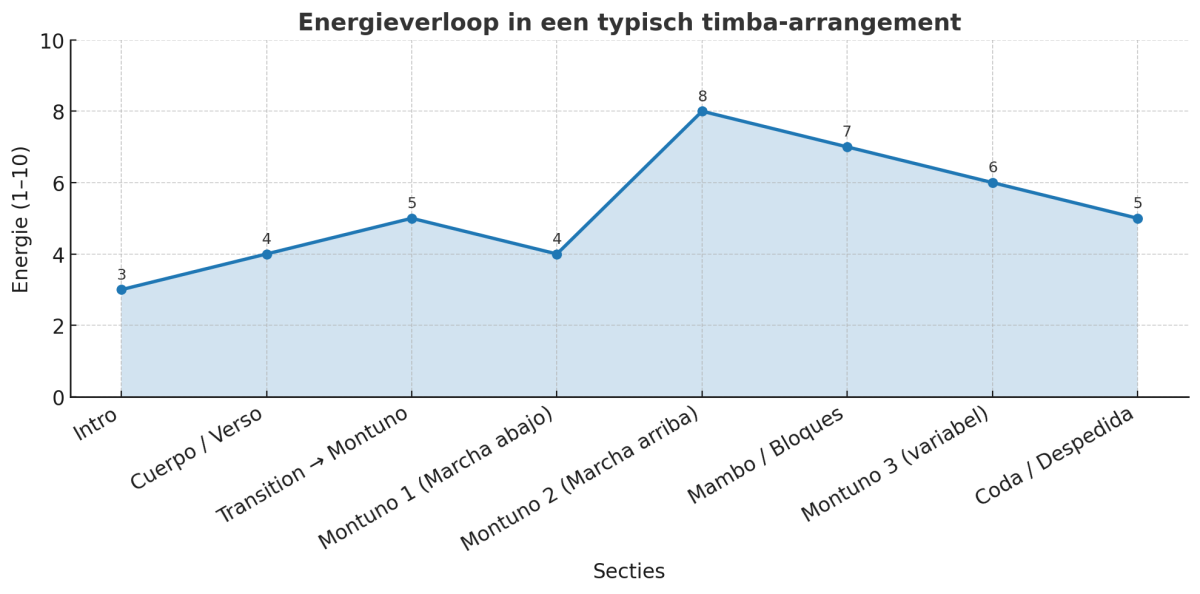
| Phase | What you hear | Energy |
|---|---|---|
| Transition to the montuno | First coro, the groove kicks in | Medium |
| Montuno 1 – marcha abajo | Calmer groove, often without campana, room for the vocals | Low–medium |
| Montuno 2 – marcha arriba | The campana comes in, full groove | High |
| Mambo / bloques | Horns and breaks, gear changes | High |
| Montuno 3 | New coros, bomba or presión, solos | Varies |
| Coda / despedida | Ending | Medium |
The difference with salsa: in salsa the montuno is often one continuous block. In timba it is a series of phases that the band colours differently each time.
🥁 The rhythm section
- Piano: tumbao (guajeo) that sets the harmony and rhythm, often with syncopated variations.
- Bass: tumbao that anticipates the beat. In the bomba it changes into slides and stomps.
- Congas: the marcha as the foundation.
- Campana and bongó: the campana drives the marcha arriba.
- Timbales and drums: accents, fills and the cues for the breaks.
💃 For dancers
- The montuno is the heart of the dance: the groove is at its most solid and the energy at its highest.
- Listen for the gear changes. In a bomba or presión the dancing often changes too, for example to despelote.
🥁 Establecer and tumbar el ritmo
- Establecer el ritmo: every percussion instrument plays its tumbao; the groove is set.
- Tumbar el ritmo: in the montuno the band builds (often through the coro) towards a climax that breaks loose the moment the full rhythm comes back in.