Timba
Timba is the music this site is dedicated to exploring. It emerged as a distinct genre in the late 1980s and crystallized in the early 1990s — born in a moment of social crisis, built on the full accumulated history of Cuban music, and still evolving today.
The Birth of Timba
NG La Banda (1988)
The band most credited with creating timba is NG La Banda (Nueva Generación La Banda), founded in 1988 by flutist and composer José Luis "El Tosco" Cortés.
El Tosco assembled a group of conservatory-trained musicians and created something deliberately aggressive, harmonically complex, and rhythmically explosive. The band's name announced their intent: nueva generación — a new generation, breaking from what came before.
NG La Banda's early recordings (En la calle and the song "La expresiva") shocked and electrified Cuban audiences. The music was too fast, too dense, too African, too raw. It was also irresistible.
Los Van Van had been moving toward timba throughout the 1980s. Juan Formell and his musicians crossed fully into the genre in the early 1990s, bringing their enormous popular following with them. If NG La Banda defined timba's aggressive edge, Los Van Van gave it popular warmth and melodic accessibility.
Timba did not emerge in a vacuum. It was born in the Período Especial en Tiempos de Paz — Cuba's catastrophic economic crisis following the collapse of the Soviet Union in 1991.
The crisis meant:
- Severe food shortages and rationing
- Electricity blackouts lasting 12–16 hours a day
- Near-collapse of public transportation
- Mass unemployment and social uncertainty
The music that emerged from this context was correspondingly intense. Timba was the sound of a generation under pressure — aggressive, irreverent, politically charged (often through coded language and street slang), and physically explosive. The despelote dance style that developed alongside it was accused of being too sexual, too African, too chaotic — and was correspondingly loved by young Cubans.
What Defines Timba
| Element |
Description |
| Gear changes |
Sudden, coordinated rhythmic shifts by the whole band — the defining structural feature; directly communicate energy levels to dancers |
| Bass |
Aggressive, improvisational, often lead voice; funk-influenced slap technique; in constant dialogue with percussion |
| Percussion |
Multiple simultaneous layers: congas, timbales, bongo/campana, drumset — all in rhythmic conversation |
| Piano |
Complex montuno patterns; jazz harmony; interacts with percussion in real time rather than repeating fixed patterns |
| Brass |
Trombone-heavy sections; powerful mambo figures; accent gear changes |
| Coros |
Call-and-response choruses; often street-influenced, humorous, or politically coded |
| Influences |
Son, rumba, songo, jazz, funk, R&B, rock — all present simultaneously |
| Form |
Intro → Diana → Canto ( verse) → Pre-coro → Coro/Montuno → Mambo sections → Gears → Coda |
Key Bands and Artists
- NG La Banda — the originators; El Tosco's trombone-heavy, aggressive sound
- Los Van Van — the populizers; Juan Formell's accessible but complex arrangements
- Isaac Delgado — the most sonero voice of the timba era; bridged traditional son phrasing with timba energy
- Charanga Habanera — David Calzado's band; the most commercially successful and controversial of the 1990s
- Manolín, El Médico de la Salsa — massive popular hit machine; brought timba to its widest Cuban audience
- Paulito FG — romantic timba; showed the genre's softer side
- Havana D'Primera — Alexander Abreu's band; the leading contemporary timba ensemble
The Dance
The dance that developed with timba was as radical as the music:
- Despelote (despelotico) — individual expression, body isolation, African movement vocabulary; controversial in Cuba for its perceived sexuality
- Suelta — a looser, more grounded individual style
- Casino — traditional partner dancing continued alongside the newer styles
- Musicality — timba dancers are expected to respond to specific musical moments (gear changes, coro entries, mambo hits) rather than simply following a generic beat
This site approaches timba from a dancer's perspective — the music becomes most alive when you understand how its structure communicates directly to your body.
Timba continues to evolve. New bands emerge, older bands continue to record and tour, and the global community of timba dancers and musicians grows. Cuban music has never stood still — and timba, true to the tradition, keeps absorbing new influences while remaining rooted in its Afro-Cuban foundation.
The thread from Nengón and Changüí in the eastern mountains to timba in the concert halls of Havana and Europe is unbroken. Every gear change in a timba song carries the history of four centuries of musical transformation.
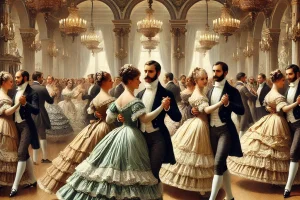
The contradanza was the first European-derived dance form to take root in Cuba and begin transforming under African influence. It is the starting point of the Cuban salon dance lineage that would eventually produce danzón, mambo, and cha-cha-chá.
Lees meer >Danzón was the first national dance of Cuba — the form that unified the island's popular music identity in the late 19th and early 20th century, and the ancestor of mambo, cha-cha-chá, and ultimately timba.
Lees meer >Timba is the music this site is dedicated to exploring. It emerged as a distinct genre in the late 1980s and crystallized in the early 1990s — born in a moment of social crisis, built on the full accumulated history of Cuban music, and still evolving today.
Lees meer >Timba is the music this site is dedicated to exploring. It emerged as a distinct genre in the late 1980s and crystallized in the early 1990s — born in a moment of social crisis, built on the full accumulated history of Cuban music, and still evolving today.
Lees meer >Songo is the direct bridge between traditional Cuban music and timba. Developed by Los Van Van in the early 1970s, it rewired Cuban popular music by absorbing funk, rock, and jazz into the Afro-Cuban rhythmic foundation — and laid every groundwork that timba would build on.
Lees meer >Songo is the direct bridge between traditional Cuban music and timba. Developed by Los Van Van in the early 1970s, it rewired Cuban popular music by absorbing funk, rock, and jazz into the Afro-Cuban rhythmic foundation — and laid every groundwork that timba would build on.
Lees meer >Rumba is the most African-rooted of all Cuban music and dance forms — born in the streets, courtyards, and docks of Havana and Matanzas in the late 19th century, with no European instruments, no salon setting, and no pretense of European propriety.
Lees meer >Rumba is the most African-rooted of all Cuban music and dance forms — born in the streets, courtyards, and docks of Havana and Matanzas in the late 19th century, with no European instruments, no salon setting, and no pretense of European propriety.
Lees meer >Casino is the Cuban partner dance born in the social clubs (casinos deportivos) of Havana in the 1950s. It is what Cubans call their own social dance — distinct from, and older than, what the rest of the world calls "salsa."
Lees meer > Cuba is the largest island in the Caribbean and the birthplace of some of the world's most influential music and dance traditions. African, Spanish, and French cultural streams collided here over centuries of colonial history, producing an extraordinary creative culture that exported itself across the globe.
Lees meer >European cultural influence on Cuba came primarily through Spain (as colonial power) and France (through the Haitian migration and Caribbean trade). These influences shaped Cuban music's harmonic language, instrumentation, and dance forms.
Lees meer > Despelote is the most explosive individual dance style in timba — a full-body release of energy that happens during the high-intensity bomba sections of a timba song.
Lees meer >Suelta is a solo timba dance style that is more grounded and contained than despelote — a cooler, more controlled individual expression that still responds directly to the music.
Lees meer >Cuban music is built on percussion. The extraordinary density and variety of Cuban rhythmic culture reflects the meeting of West and Central African drumming traditions with Spanish, Haitian, and creole musical practices over four centuries. The instruments below form the core percussive vocabulary heard across Son, Rumba, Timba, Danzón, and their descendants.
Lees meer >
The bongo is a pair of small open-bottomed drums played with fingers and palms. It originated in eastern Cuba and became one of the defining percussion voices of son and timba.
Lees meer >The timbales ( pailas criollas) are a pair of shallow, metal-shell drums mounted on a stand, played with wooden sticks. They are the rhythmic engine of charanga orchestras and play a critical role in timba.
Lees meer >The piano is the harmonic and rhythmic heart of Cuban popular music. In timba, it is one of the most demanding and expressive instruments in the ensemble.
Lees meer >The piano is the harmonic and rhythmic heart of Cuban popular music. In timba, it is one of the most demanding and expressive instruments in the ensemble.
Lees meer > Timba, the explosive and rhythmically rich genre of Cuban dance music, transformed how the bass functions in popular music. In Timba, the bass is not just foundational — it’s fiery, funky, and free.
Lees meer >The trombone is the defining brass voice of timba. Where earlier Cuban popular music relied primarily on trumpets, timba shifted the brass weight toward trombones — giving the music a deeper, darker, more aggressive horn sound.
Lees meer >A Cuban popular dance music genre that emerged in the 1980s–90s
- emerged in the 1980s–90s
- influenced by songo, rumba, funk, blues, jazz, pop, rock and Afro-Cuban rhythms.
- Known for complex rhythm shifts, aggressive bass lines, and high energy that push dancers to improvise.
Lees meer >Gear changes, or "cambios de marcha," in Timba are particularly thrilling elements that contribute to the genre's dynamism and energy. These changes are essentially shifts in rhythm, tempo, or even in the music's texture that inject excitement and often encourage dance floor responses. They are used strategically throughout a song to create tension and release, keep the audience engaged, and highlight the musicians' versatility and creativity.
Lees meer >
- Who sings it Chorus (the coristas, sometimes the horns too)
- Purpose Repetition, hook and rhythmic anchor
- Characteristics Short, catchy, often syncopated
Lees meer >A vocal improvisation or melodic gesture, sometimes used to transition between sections, often marking the move into the montuno or to reintroduce energy.
Lees meer >The cuerpo, also called canto, largo or verse, is where the lead vocalist sings the main lyrical content of the song.
In Timba, the canto often contains a narrative or thematic element and is supported by the rhythm section and background vocals.
Lees meer >The cuerpo, also called canto, largo or verse, is where the lead vocalist sings the main lyrical content of the song.
In Timba, the canto often contains a narrative or thematic element and is supported by the rhythm section and background vocals.
Lees meer >Introducción / Diana
This is the opening section of the song, which sets the mood and introduces the musical motifs.
It often features a horn section and can include elements from the song's main themes.
The conclusion of the song, which often mirrors the intro or brings the song to a close with a final statement by the band.
Lees meer >The horn layer over the montuno: short, powerful and rhythmically intense riffs that the horns lay over the ongoing groove, building energy toward the climax of the song.
Lees meer >