Cha-Cha-Cha
Cha-cha-chá is a Cuban dance music rhythm created in 1953 by violinist and composer Enrique Jorrín while performing with the Orquesta América, a charanga ensemble based in Havana. It became one of the most successful Cuban music exports of the 20th century, spreading rapidly through Latin America, Europe, and North America.
Origin
The cha-cha-chá grew directly out of the danzón-mambo, the rhythmically innovative style that Antonio Arcaño, Orestes López, and Israel "Cachao" López had developed at the end of the 1940s. Jorrín observed that dancers were struggling with the syncopated complexity of the mambo section — the improvised, heavily syncopated final montuno section demanded real rhythmic sophistication from dancers who were accustomed to the more stately danzón.
His solution was to slow the tempo slightly and shift the rhythmic accent to create a cleaner, more audible beat that dancers could follow without specialized training. The three-note rhythmic figure that fell on the fourth beat and the "and" of four produced a shuffling sound that audiences began to vocalize as "cha-cha-chá" while dancing.
Jorrín's composition "La Engañadora" (1953) is considered the first true cha-cha-chá. Its success with dancers at the Tropicana and La Paloma clubs in Havana confirmed that the new rhythm had mass appeal.
The Rhythmic Pattern
The defining feature of the cha-cha-chá beat is the "cha-cha-chá" figure that falls at the end of each two-beat phrase. In 4/4 time, the basic feel is:
- Beat 1: step
- Beat 2: step
- Beat 3: step
- Beat 4-and-1: cha – cha – chá (three quick notes closing the phrase)
This creates an even, accessible rhythm that lands clearly on the downbeats while the characteristic "cha-cha-chá" figure gives the music its playful, characteristic bounce. Compared to the mambo's driving, syncopated thrust, the cha-cha-chá feels measured and conversational.
The timbales play a central role in marking this pattern. The cascara (striking the shell of the timbales rather than the head) keeps a driving sixteenth-note feel, while the open timbale strokes punctuate the "cha-cha-chá" figure. The güiro (a ridged gourd scraped rhythmically) provides a continuous sixteenth-note subdivision that locks the feel together.
Cha-cha-chá is inseparable from the charanga format. The standard charanga instrumentation — flute, two or more violins, piano, bass, timbales, güiro, and vocals — gives the rhythm its characteristic sound:
- The flute carries the main melodic line and improvises in the upper register.
- The violins play harmonized rhythmic figures (guajeos) that give the rhythm section a chamber-music quality absent in brass-heavy conjuntos.
- The piano comps in a light, offbeat pattern that complements the flute and strings.
- The bass walks a tumbao that outlines the harmony without the heavy low-end punch of later styles.
- The güiro is rhythmically essential — its continuous scraping pattern is one of the sonic signatures of cha-cha-chá.
The lightness and elegance of charanga orchestration suited cha-cha-chá perfectly. The sound was refined enough for the elite dance halls of Havana while being rhythmically accessible enough to attract social dancers of all backgrounds.
Relationship to the Dance
The cha-cha-chá gave rise to a specific social dance of the same name. Dancers take three steps on counts 4-and-1 — the "cha-cha-chá" shuffle — and two weight changes on counts 2 and 3. This simple structure made it far more accessible than mambo or danzón.
The dance is performed with partners facing each other in a closed or open hold, moving with contained, neat footwork. There is no dramatic dip or elaborate turn pattern by default — the emphasis is on clean timing, light footwork, and playful interaction between partners.
Because the beat is so clear and the steps so logical, cha-cha-chá became the entry point into Cuban dance for millions of social dancers worldwide. In Cuba, it remains a standard in any dance evening alongside son and casino.
How It Differs from Mambo and Danzón
| Feature |
Danzón |
Mambo |
Cha-cha-chá |
| Tempo |
Slow to moderate |
Fast, driving |
Moderate |
| Feel |
Elegant, restrained |
Syncopated, aggressive |
Playful, accessible |
| Dance complexity |
High (for its era) |
High |
Low to medium |
| Rhythmic accent |
On-beat, formal |
Heavily syncopated |
Clear, with cha-cha-chá figure |
| Typical ensemble |
Charanga / orquesta típica |
Big band or conjunto |
Charanga |
Danzón is the stately ancestor — formal, largely instrumental, with alternating sections and a resting convention for couples. Mambo took danzón's improvisatory final section and turbocharged it with brass, percussion, and jazz harmony. Cha-cha-chá preserved charanga's elegant instrumentation while making the rhythm transparent and body-friendly.
Key Recordings
- Enrique Jorrín / Orquesta América – La Engañadora (1953) — the founding recording
- Orquesta Aragón – El Bodeguero — the most famous cha-cha-chá internationally
- Fajardo y Sus Estrellas – exemplary 1950s charanga cha-cha-chá
- Xavier Cugat — introduced the rhythm to North American audiences
- "Ophicleide or tuba (later replaced by contrabass)"
Lees meer >Dances
- Danzón – The quintessential Cuban ballroom dance, elegant and formal, often seen as the "national dance of Cuba."
- Danzonete – A sung variant of danzón that became popular in the 1920s–30s.
- Cha-cha-chá – Created in the 1950s by Enrique Jorrín while playing with a charanga; specifically designed for charanga orchestras.
- Pachanga – A playful dance and rhythm from the late 1950s/early 1960s, closely linked to charanga bands.
- Mambo (in its earlier Cuban form) – Before the big-band New York mambo, charangas also played early mambo-style danzones.
- Charanga is a Cuban ensemble style and musical tradition that dates back to the early 20th century. It became especially popular in the 1940s–50s and played a crucial role in the evolution of salsa, timba, and Latin jazz.
Lees meer >Rumba is the most African-rooted of all Cuban music and dance forms — born in the streets, courtyards, and docks of Havana and Matanzas in the late 19th century, with no European instruments, no salon setting, and no pretense of European propriety.
Lees meer >The horn layer over the montuno: short, powerful and rhythmically intense riffs that the horns lay over the ongoing groove, building energy toward the climax of the song.
Lees meer >Casino is the Cuban partner dance born in the social clubs (casinos deportivos) of Havana in the 1950s. It is what Cubans call their own social dance — distinct from, and older than, what the rest of the world calls "salsa."
Lees meer >Cuba is the largest island in the Caribbean and the birthplace of some of the world's most influential music and dance traditions. African, Spanish, and French cultural streams collided here over centuries of colonial history, producing an extraordinary creative culture that exported itself across the globe.
Lees meer >European cultural influence on Cuba came primarily through Spain (as colonial power) and France (through the Haitian migration and Caribbean trade). These influences shaped Cuban music's harmonic language, instrumentation, and dance forms.
Lees meer >The Tropicana is Havana's most famous cabaret and one of the great entertainment venues of the 20th century. Opened in 1939 in the Marianao neighborhood, it became a symbol of Cuban showmanship — elaborate choreography, live orchestras, and spectacular staging performed under an open-air canopy of trees.
Lees meer >EGREM (Empresa de Grabaciones y Ediciones Musicales) is Cuba's state recording company, founded in 1964 after the Revolution nationalized all private recording labels. Its main facility, Estudios Areíto in Havana, is where virtually every important Cuban recording from the Revolution era was made.
Lees meer >Egungun is the Yoruba masquerade tradition honoring the collective ancestors — the Egun, the dead who remain present and active in the lives of the living. In Cuba, the Egungun tradition survived within the broader world of Santería (Regla de Ocha) and the related Arará and Abakuá communities, though in a form shaped by the specific conditions of the island.
Lees meer >Cuban music is built on percussion. The extraordinary density and variety of Cuban rhythmic culture reflects the meeting of West and Central African drumming traditions with Spanish, Haitian, and creole musical practices over four centuries. The instruments below form the core percussive vocabulary heard across Son, Rumba, Timba, Danzón, and their descendants.
Lees meer >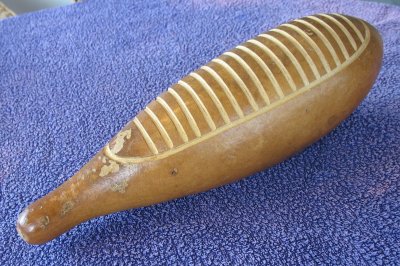
The güiro is a notched gourd scraped with a stick or fork to produce a rasping, rhythmic sound. It is a standard feature of charanga orchestras and is central to danzón, cha-cha-chá, son, and salsa.
Lees meer >The timbales (pailas criollas) are a pair of shallow, metal-shell drums mounted on a stand, played with wooden sticks. They are the rhythmic engine of charanga orchestras and play a critical role in timba.
Lees meer >The timbales (pailas criollas) are a pair of shallow, metal-shell drums mounted on a stand, played with wooden sticks. They are the rhythmic engine of charanga orchestras and play a critical role in timba.
Lees meer >The piano is the harmonic and rhythmic heart of Cuban popular music. In timba, it is one of the most demanding and expressive instruments in the ensemble.
Lees meer >The piano is the harmonic and rhythmic heart of Cuban popular music. In timba, it is one of the most demanding and expressive instruments in the ensemble.
Lees meer >The piano is the harmonic and rhythmic heart of Cuban popular music. In timba, it is one of the most demanding and expressive instruments in the ensemble.
Lees meer >Timba, the explosive and rhythmically rich genre of Cuban dance music, transformed how the bass functions in popular music. In Timba, the bass is not just foundational — it’s fiery, funky, and free.
Lees meer >The flute is the lead voice of the charanga, from Antonio Arcaño's wooden five-key flute to Orquesta Aragón. In timba it returns with bright melodies, call-and-response with the singers, and virtuoso solos that cut through the dense rhythm section.
Lees meer >The trombone is the defining brass voice of timba. Where earlier Cuban popular music relied primarily on trumpets, timba shifted the brass weight toward trombones — giving the music a deeper, darker, more aggressive horn sound.
Lees meer >