Spain - place
Spain colonized Cuba from 1492 to 1898, fundamentally shaping its language, religion, harmonic music traditions, and social structure. Spanish musical culture forms one of the two primary roots — alongside African traditions — of virtually all Cuban music.
Instrumentation
The core melodic instruments of Cuban music are Spanish-derived:
Song Forms
The Cuban Bolero descends from the Andalusian bolero, transformed in cuba"> Santiago de Cuba in the late 19th century into a slow, intimate song form. Pepe Sánchez ( Santiago, 1856–1918) is credited as the father of the Cuban Bolero.
The trova — lyric song composition with guitar — comes directly from the Spanish troubadour tradition. Cuba's vieja trova produced composers like Sindo Garay and Compay Segundo; the nueva trova continues the line today.
The Spanish contradanza (absorbed from the French contredanse) arrived in Cuba and was creolized into the Contradanza cubana — the ancestor of Danzón, Mambo, and Cha-cha-chá.
Harmonic Language
European tonal harmony — major/minor keys, functional chord progressions — underlies all Cuban popular music. The clave rhythm organizes African-derived polyrhythm within European harmonic frameworks. The tension between these two systems is exactly what gives Cuban music its characteristic drive.
Key Spanish-Connected Figures
- Pepe Sánchez — founded the Cuban Bolero tradition in Santiago
- Sindo Garay — master of the trovador tradition, cuba"> Santiago de Cuba
- Manuel Saumell — Havana composer who established the Contradanza cubana as a concert form
- Ignacio Cervantes — pianist and composer, studied in Paris, built on the Contradanza tradition
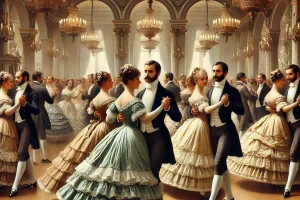
The contradanza was the first European-derived dance form to take root in Cuba and begin transforming under African influence. It is the starting point of the Cuban salon dance lineage that would eventually produce danzón, mambo, and cha-cha-chá.
Lees meer >
The contradanza was the first European-derived dance form to take root in Cuba and begin transforming under African influence. It is the starting point of the Cuban salon dance lineage that would eventually produce danzón, mambo, and cha-cha-chá.
Lees meer >Danzón was the first national dance of Cuba — the form that unified the island's popular music identity in the late 19th and early 20th century, and the ancestor of mambo, cha-cha-chá, and ultimately timba.
Lees meer >Danzón was the first national dance of Cuba — the form that unified the island's popular music identity in the late 19th and early 20th century, and the ancestor of mambo, cha-cha-chá, and ultimately timba.
Lees meer >Timba is the music this site is dedicated to exploring. It emerged as a distinct genre in the late 1980s and crystallized in the early 1990s — born in a moment of social crisis, built on the full accumulated history of Cuban music, and still evolving today.
Lees meer >Rumba is the most African-rooted of all Cuban music and dance forms — born in the streets, courtyards, and docks of Havana and Matanzas in the late 19th century, with no European instruments, no salon setting, and no pretense of European propriety.
Lees meer >The Cuban bolero is one of the great romantic song traditions of the world — slow, intimate, and deeply emotional. It is entirely distinct from the Spanish bolero (a fast 3/4 dance) and emerged in Cuba as a vehicle for the island's most heartfelt lyric expression.
Lees meer >The Cuban bolero is one of the great romantic song traditions of the world — slow, intimate, and deeply emotional. It is entirely distinct from the Spanish bolero (a fast 3/4 dance) and emerged in Cuba as a vehicle for the island's most heartfelt lyric expression.
Lees meer >The cha-cha-chá was born from a simple observation: dancers were struggling to follow mambo. Its creator gave them a rhythm they could feel in their feet — and the result became one of the most danced music styles in history.
Lees meer >Cuba is the largest island in the Caribbean and the birthplace of some of the world's most influential music and dance traditions. African, Spanish, and French cultural streams collided here over centuries of colonial history, producing an extraordinary creative culture that exported itself across the globe.
Lees meer >Matanzas has its own Casa de la Trova, reflecting the city's deep musical culture. Often called the "Athens of Cuba" for its cultural richness, Matanzas is the birthplace of Danzón, the stronghold of Rumba (particularly Yambú and Guaguancó), and home to the oldest living Abakuá and Arará traditions.
Lees meer >The Casa de la Trova in Santiago de Cuba is the spiritual home of Cuban traditional music — Son, Bolero, Changüí, and Trova. Founded in 1968 on Calle Heredia in the heart of Santiago's historic center, it has been the gathering place for the city's musicians for over half a century.
Lees meer >Spain colonized Cuba from 1492 to 1898, fundamentally shaping its language, religion, harmonic music traditions, and social structure. Spanish musical culture forms one of the two primary roots — alongside African traditions — of virtually all Cuban music.
Lees meer >Egungun is the Yoruba masquerade tradition honoring the collective ancestors — the Egun, the dead who remain present and active in the lives of the living. In Cuba, the Egungun tradition survived within the broader world of Santería (Regla de Ocha) and the related Arará and Abakuá communities, though in a form shaped by the specific conditions of the island.
Lees meer >
The clave is a fundamental rhythmic pattern and organizing principle in Cuban music. It serves as both a musical pattern and a guiding concept, deeply rooted in Afro-Cuban traditions.
Lees meer >
The tres is a Cuban guitar-like instrument with three pairs (courses) of strings. It is the defining melodic-rhythmic instrument of son cubano and its ancestor genres.
Lees meer >The Spanish guitar arrived in Cuba with the colonizers and became the seed of Cuban music, blending with African rhythms. From inspiring the tres to shaping son, conjuntos, and even modern timba, its influence runs through every note of Cuba’s musical history.
Lees meer >The piano is the harmonic and rhythmic heart of Cuban popular music. In timba, it is one of the most demanding and expressive instruments in the ensemble.
Lees meer >In timba (the Cuban genre that evolved from son and salsa in the late 1980s and 1990s), the violin is not a core instrument, but it does appear in interesting ways:
Lees meer >The trumpet has been central to Cuban popular music since the 1920s, when it became the lead melodic voice of the son septeto — the "seventh voice" that transformed the ensemble.
Lees meer >A Cuban popular dance music genre that emerged in the 1980s–90s
- emerged in the 1980s–90s
- influenced by songo, rumba, funk, blues, jazz, pop, rock and Afro-Cuban rhythms.
- Known for complex rhythm shifts, aggressive bass lines, and high energy that push dancers to improvise.
Lees meer >Mambo
In Cuban music, especially in salsa and son,
the "mambo" section typically refers to a brassy, rhythmically intense instrumental break,
often featuring repetitive horn lines, call-and-response patterns, and building energy toward the climax of a song.
The Casa de la Trova in Santiago de Cuba is the spiritual home of Cuban traditional music — Son, Bolero, Changüí, and Trova. Founded in 1968 on Calle Heredia in the heart of Santiago's historic center, it has been the gathering place for the city's musicians for over half a century.
Lees meer >