Clarinet
The clarinet was one of the characteristic instruments of the orquesta típica, the wind band that played early danzón.
🎷 In the orquesta típica
The orquestas típicas of the late 19th century were based on wind instruments: brass such as the cornet, valve trombone and ophicleide, plus a clarinet or two, a violin or two, timpani and güiro. The clarinet often played the melody and ornaments, and gave the típica its bright, somewhat military sound.
🎻 From típica to charanga
At the beginning of the 20th century the charanga emerged: a smaller, lighter and more elegant orchestra with two violins, cello, flute, timbales, güiro and double bass, without clarinet. For years both existed side by side, but after 1930 the days of the típica were over. The flute took over the clarinet's role as the leading woodwind.
💃 For dancers
If you hear a clarinet in a danzón, you are listening to the older típica sound. It is the same danzón, but with a fuller, more solemn character than the later charanga.
📝 Sources
The danzón is Cuba's elegant "national dance" from 1879: a salon dance of the orquesta típica and later the charanga, and an important step towards mambo and cha-cha-chá.
Lees meer >Dances
- Danzón – The quintessential Cuban ballroom dance, elegant and formal, often seen as the "national dance of Cuba."
- Danzonete – A sung variant of danzón that became popular in the 1920s–30s.
- Cha-cha-chá – Created in the 1950s by Enrique Jorrín while playing with a charanga; specifically designed for charanga orchestras.
- Pachanga – A playful dance and rhythm from the late 1950s/early 1960s, closely linked to charanga bands.
- Mambo (in its earlier Cuban form) – Before the big-band New York mambo, charangas also played early mambo-style danzones.
- Charanga is a Cuban ensemble style and musical tradition that dates back to the early 20th century. It became especially popular in the 1940s–50s and played a crucial role in the evolution of salsa, timba, and Latin jazz.
Lees meer >The timpani (kettledrum) played a foundational role in Cuban music history as the original pitched drum of the 19th-century orquesta típica — before being replaced by the lighter timbales.
Lees meer >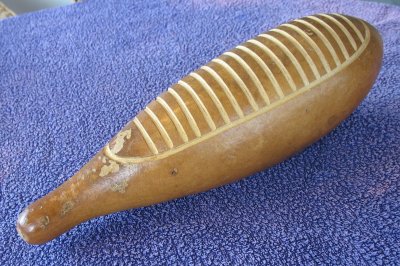
The güiro is a notched gourd scraped with a stick or fork to produce a rasping, rhythmic sound. It is a standard feature of charanga orchestras and is central to danzón, cha-cha-chá, son, and salsa.
Lees meer >The timbales (pailas criollas) are a pair of shallow, metal-shell drums mounted on a stand, played with wooden sticks. They are the rhythmic engine of charanga orchestras and play a critical role in timba.
Lees meer >Timba, the explosive and rhythmically rich genre of Cuban dance music, transformed how the bass functions in popular music. In Timba, the bass is not just foundational — it’s fiery, funky, and free.
Lees meer >The cornet is a brass instrument that looks a lot like the trumpet, but has a warmer, mellower tone. In Cuba it played a leading role in the orquesta típica, the wind band of early danzón.
Lees meer >The ophicleide and the tuba were the bass instruments of the orquesta típica, the wind band that played early danzón. Later the double bass took over their role.
Lees meer >The flute is the lead voice of the charanga, from Antonio Arcaño's wooden five-key flute to Orquesta Aragón. In timba it returns with bright melodies, call-and-response with the singers, and virtuoso solos that cut through the dense rhythm section.
Lees meer >The trombone is the defining brass voice of timba. Where earlier Cuban popular music relied primarily on trumpets, timba shifted the brass weight toward trombones — giving the music a deeper, darker, more aggressive horn sound.
Lees meer >