Enrique Jorrín
Creator of the cha-cha-chá — Enrique Jorrín developed the genre in the early 1950s as a slower, more accessible version of the mambo that Cuban social dancers could actually dance to without acrobatics. His 1953 composition "La Engañadora" is recognized as the first true cha-cha-chá.
Background and Musical Formation
Jorrín was born on December 25, 1926, in Canillas, Pinar del Río province, in western Cuba. He received formal musical training and became a skilled violinist, eventually moving to Havana where the professional music world was centered.
He joined the Orquesta América, a Havana-based charanga ensemble, where he played violin as part of the string section. The charanga format — flute, violins, piano, bass, timbales, güiro, and vocals — was the standard for elegant Havana dance music in the 1940s and 1950s, and the Orquesta América was one of its respected practitioners.
Working in this charanga context meant Jorrín was immersed in the repertoire and social dance conventions of the era, including the danzón and the newer danzón-mambo style that had emerged from the innovations of Antonio Arcaño and the López brothers.
The Problem He Observed
By the early 1950s, the danzón-mambo (or nuevo ritmo danzón) was enormously popular in Havana's dance halls. But Jorrín, as a working musician watching dancers every night, noticed a problem: the improvised, syncopated mambo section at the end of these danzones was rhythmically complex enough that many dancers were unable to follow it confidently. The montuno section required an internalized feel for Cuban rhythmic syncopation that not all social dancers possessed.
Dancers were sometimes stopping and watching rather than dancing when the mambo section arrived, or improvising uncertain footwork without conviction.
Jorrín's insight was practical: if the rhythmic pattern were made clearer — more audible, more regular, with a definite accent that the feet could find naturally — the music would be more danceable for a broader audience without sacrificing energy or charm.
Around 1952–1953, Jorrín began experimenting with compositions that modified the tempo and rhythmic emphasis of the mambo section. He slowed the tempo slightly and shifted the rhythmic accent so that a clear three-note figure fell at the end of each two-beat phrase, precisely on the beat subdivision where dancers' feet would naturally want to shuffle.
This three-note figure — dancers began to vocalize it as "cha-cha-chá" while performing the three-step shuffle — gave the new rhythm its name.
The result preserved:
- The charanga orchestration (flute, violins, piano, bass, güiro, timbales)
- The call-and-response vocal structure of Cuban dance music
- The rhythmic life and syncopation of the mambo tradition
While making:
- The beat pattern transparent and physically intuitive
- The tempo accessible for social dancers of all skill levels
- The overall feel lighter and more playful than the aggressive mambo
The key innovation was not making simpler music but making rhythmically transparent music — music where the beat was fully audible in the sound of the ensemble.
"La Engañadora" (1953)
Jorrín composed "La Engañadora" (The Deceiver) with lyrics referencing a woman on the Prado boulevard in Havana who attracted admirers despite padded clothing enhancing her figure — a piece of wry social observation typical of Cuban popular songwriting.
The premiere of "La Engañadora" in 1953 at Havana's Silver Club (and its subsequent performances at the Tropicana and other venues) caused an immediate sensation. Dancers responded to the new rhythm with the three-step shuffle that audiences and dancers alike were vocalizing as "cha-cha-chá."
Jorrín followed with further compositions in the new style, and other charanga bands quickly adopted and recorded cha-cha-chás. The rhythm spread through Cuba within months and reached international audiences within a few years.
Spread and International Impact
By 1954–1955, cha-cha-chá had become the dominant popular dance music in Cuba, displacing the mambo in the dance halls where it had previously reigned. The charanga format — ideally suited to cha-cha-chá's light, clean sound — experienced a major revival.
International spread came through:
- Orquesta Aragón's recording of "El Bodeguero" — the most famous single cha-cha-chá internationally
- Tours by Cuban charanga bands to Mexico, the United States, and Europe
- Commercial recordings on American labels
- The simplicity of the dance, which could be taught in ballroom dance schools worldwide without requiring deep immersion in Cuban rhythmic culture
Arthur Murray dance studios in the United States promoted cha-cha-chá heavily, and the dance became a staple of the ballroom dance curriculum globally.
Jorrín and the Orquesta América
Jorrín continued performing and recording with the Orquesta América and led his own ensembles. He remained a respected figure in Cuban music throughout the 1960s and 1970s, even as newer styles — Songo, Timba — took center stage. His compositions remained in the active repertoire of Cuban dance ensembles.
He composed dozens of cha-cha-chás beyond "La Engañadora", including "La bella cubana", "Rico vacilón", and "Silver Star", each contributing to the genre's vocabulary.
Legacy
Enrique Jorrín died on December 12, 1987, in Havana.
His creation of the cha-cha-chá was a genuine structural innovation — not a minor stylistic adjustment but a rethinking of how Cuban dance music rhythm could be presented. By making the rhythm legible to dancers without prior Afro-Cuban musical education, he opened the door to an audience far larger than Cuban popular music had previously reached.
The cha-cha-chá remains one of the five standard ballroom dance rhythms taught in dance schools worldwide. Every social dancer who has done the three-step shuffle is carrying forward the insight that a Havana violinist had one night watching dancers struggle with the mambo section.
Key Recordings
- "La Engañadora" (1953) — the first cha-cha-chá
- Orquesta América — various recordings with Jorrín, early 1950s
- Orquesta Aragón — "El Bodeguero" (composed by Richard Egüés, the Aragón style expanded the tradition Jorrín began)
Timba is the music this site is dedicated to exploring. It emerged as a distinct genre in the late 1980s and crystallized in the early 1990s — born in a moment of social crisis, built on the full accumulated history of Cuban music, and still evolving today.
Lees meer >Rumba is the most African-rooted of all Cuban music and dance forms — born in the streets, courtyards, and docks of Havana and Matanzas in the late 19th century, with no European instruments, no salon setting, and no pretense of European propriety.
Lees meer >The cha-cha-chá was born from a simple observation: dancers were struggling to follow mambo. Its creator gave them a rhythm they could feel in their feet — and the result became one of the most danced music styles in history.
Lees meer >Songo is the direct bridge between traditional Cuban music and timba. Developed by Los Van Van in the early 1970s, it rewired Cuban popular music by absorbing funk, rock, and jazz into the Afro-Cuban rhythmic foundation — and laid every groundwork that timba would build on.
Lees meer > Cuba is the largest island in the Caribbean and the birthplace of some of the world's most influential music and dance traditions. African, Spanish, and French cultural streams collided here over centuries of colonial history, producing an extraordinary creative culture that exported itself across the globe.
Lees meer >European cultural influence on Cuba came primarily through Spain (as colonial power) and France (through the Haitian migration and Caribbean trade). These influences shaped Cuban music's harmonic language, instrumentation, and dance forms.
Lees meer >The Tropicana is Havana's most famous cabaret and one of the great entertainment venues of the 20th century. Opened in 1939 in the Marianao neighborhood, it became a symbol of Cuban showmanship — elaborate choreography, live orchestras, and spectacular staging performed under an open-air canopy of trees.
Lees meer > EGREM (Empresa de Grabaciones y Ediciones Musicales) is Cuba's state recording company, founded in 1964 after the Revolution nationalized all private recording labels. Its main facility, Estudios Areíto in Havana, is where virtually every important Cuban recording from the Revolution era was made.
Lees meer >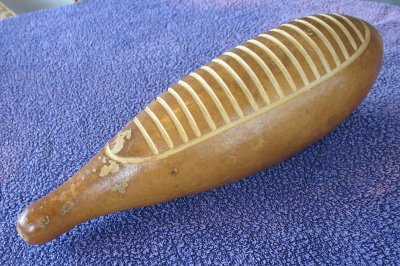
The güiro is a notched gourd scraped with a stick or fork to produce a rasping, rhythmic sound. It is a standard feature of charanga orchestras and is central to danzón, cha-cha-chá, son, and salsa.
Lees meer >The timbales ( pailas criollas) are a pair of shallow, metal-shell drums mounted on a stand, played with wooden sticks. They are the rhythmic engine of charanga orchestras and play a critical role in timba.
Lees meer >The piano is the harmonic and rhythmic heart of Cuban popular music. In timba, it is one of the most demanding and expressive instruments in the ensemble.
Lees meer >The piano is the harmonic and rhythmic heart of Cuban popular music. In timba, it is one of the most demanding and expressive instruments in the ensemble.
Lees meer >In timba (the Cuban genre that evolved from son and salsa in the late 1980s and 1990s), the violin is not a core instrument, but it does appear in interesting ways:
Lees meer > Timba, the explosive and rhythmically rich genre of Cuban dance music, transformed how the bass functions in popular music. In Timba, the bass is not just foundational — it’s fiery, funky, and free.
Lees meer >A Cuban popular dance music genre that emerged in the 1980s–90s
- emerged in the 1980s–90s
- influenced by songo, rumba, funk, blues, jazz, pop, rock and Afro-Cuban rhythms.
- Known for complex rhythm shifts, aggressive bass lines, and high energy that push dancers to improvise.
Lees meer >Mambo
In Cuban music, especially in salsa and son,
the "mambo" section typically refers to a brassy, rhythmically intense instrumental break,
often featuring repetitive horn lines, call-and-response patterns, and building energy toward the climax of a song.
The Casa de la Trova in Santiago de Cuba is the spiritual home of Cuban traditional music — Son, Bolero, Changüí, and Trova. Founded in 1968 on Calle Heredia in the heart of Santiago's historic center, it has been the gathering place for the city's musicians for over half a century.
Lees meer >Montuno
🛎️ 1. General Role of the Cowbell
The montuno is the call-and-response section near the end of a salsa or son tune, where everything opens up rhythmically.
- The cowbell pattern becomes steady and driving, often the “salsa bell” pattern:
(Hits on 1, the “&” of 2, 4, and the “&” of 4)
So:
🕐 Cowbell = timekeeper
🎹 Piano = syncopation
🎺 Horns/voices = call & response
- Literally “march down” — this section is calmer, often before the montuno.
- The cowbell is not usually played here.
Instead, you mostly hear congas, bongos, and timbales on softer instruments like the cáscara (timbale shell pattern).
- The rhythm is more subtle, leaving space for vocals or melodic content.
So:
In marcha abajo, the cowbell rests or plays lightly (if at all), and rhythmic emphasis is on cáscara or bongó martillo.
- “March up” — this means the groove intensifies.
- The cowbell comes in strong, providing the main pulse.
- The timbalero usually plays the large cowbell ( campana), while the bongocero might play the smaller bell for contrast.
- This section is about energy and drive — dance climax.
So:
In marcha arriba, the cowbell leads the rhythm section, locking in with the bass and clave to propel the music forward.
🧭 Summary Table
| Section |
Cowbell Player |
Function |
Typical Pattern |
Energy |
| Marcha abajo |
Usually silent or light (cáscara instead) |
Keeps groove subtle |
Cáscara on timbales |
Low–Medium |
| Montuno |
Bongocero (small bell) |
Keeps steady timeline for montuno section |
Salsa bell pattern |
Medium–High |
| Marcha arriba |
Timbalero (big bell) |
Drives rhythm, peak energy |
Salsa bell (louder, heavier) |
High |
Would you like me to add rhythmic notation (in 2–3 and 3–2 clave alignment) for each section’s cowbell pattern? That can make it easier to visualize how it fits with the rest of the rhythm section.
The Casa de la Trova in Santiago de Cuba is the spiritual home of Cuban traditional music — Son, Bolero, Changüí, and Trova. Founded in 1968 on Calle Heredia in the heart of Santiago's historic center, it has been the gathering place for the city's musicians for over half a century.
Lees meer >
The bongo is a pair of small open-bottomed drums played with fingers and palms. It originated in eastern Cuba and became one of the defining percussion voices of son and timba.
Lees meer >
The bongo is a pair of small open-bottomed drums played with fingers and palms. It originated in eastern Cuba and became one of the defining percussion voices of son and timba.
Lees meer >
The bongo is a pair of small open-bottomed drums played with fingers and palms. It originated in eastern Cuba and became one of the defining percussion voices of son and timba.
Lees meer >Cuban Timba & Songo
How to Dance to the Campana (Cowbell)
In Cuban timba and songo, the campana (cowbell) is not just a rhythm — it is a communication system between the band and the dancers.
Lees meer >Cuban Timba & Songo
How to Dance to the Campana (Cowbell)
In Cuban timba and songo, the campana (cowbell) is not just a rhythm — it is a communication system between the band and the dancers.
Lees meer >
The clave is a fundamental rhythmic pattern and organizing principle in Cuban music. It serves as both a musical pattern and a guiding concept, deeply rooted in Afro-Cuban traditions.
Lees meer >The timbales (pailas criollas) are a pair of shallow, metal-shell drums mounted on a stand, played with wooden sticks. They are the rhythmic engine of charanga orchestras and play a critical role in timba.
Lees meer >The piano is the harmonic and rhythmic heart of Cuban popular music. In timba, it is one of the most demanding and expressive instruments in the ensemble.
Lees meer >The piano is the harmonic and rhythmic heart of Cuban popular music. In timba, it is one of the most demanding and expressive instruments in the ensemble.
Lees meer >Timba, the explosive and rhythmically rich genre of Cuban dance music, transformed how the bass functions in popular music. In Timba, the bass is not just foundational — it’s fiery, funky, and free.
Lees meer >The terms "marcha abajo" and "marcha arriba" describe different energy levels or sections within the montuno.
Lees meer >The terms "marcha abajo" and "marcha arriba" describe different energy levels or sections within the montuno.
Lees meer >Montuno
The cowbell
🛎️ 1. General Role of the Cowbell
🎹 2. Montuno Section
The montuno is the call-and-response section near the end of a salsa or son tune, where everything opens up rhythmically.
- The cowbell pattern becomes steady and driving, often the “salsa bell” pattern:
(Hits on 1, the “&” of 2, 4, and the “&” of 4)
- The bongocero switches from hand drums to cowbell at this point.
- The cowbell keeps time over the clave and supports the montuno piano pattern, bass tumbao, and horn riffs.
So:
🕐 Cowbell = timekeeper
🎹 Piano = syncopation
🎺 Horns/voices = call & response
🔻 3. Marcha Abajo (Down Section)
- Literally “march down” — this section is calmer, often before the montuno.
- The cowbell is not usually played here.
Instead, you mostly hear congas, bongos, and timbales on softer instruments like the cáscara (timbale shell pattern).
- The rhythm is more subtle, leaving space for vocals or melodic content.
So:
In marcha abajo, the cowbell rests or plays lightly (if at all), and rhythmic emphasis is on cáscara or bongó martillo.
🔺 4. Marcha Arriba (Up Section)
- “March up” — this means the groove intensifies.
- The cowbell comes in strong, providing the main pulse.
- The timbalero usually plays the large cowbell (campana), while the bongocero might play the smaller bell for contrast.
- This section is about energy and drive — dance climax.
So:
In marcha arriba, the cowbell leads the rhythm section, locking in with the bass and clave to propel the music forward.
🧭 Summary Table
| Section |
Cowbell Player |
Function |
Typical Pattern |
Energy |
| Marcha abajo |
Usually silent or light (cáscara instead) |
Keeps groove subtle |
Cáscara on timbales |
Low–Medium |
| Montuno |
Bongocero (small bell) |
Keeps steady timeline for montuno section |
Salsa bell pattern |
Medium–High |
| Marcha arriba |
Timbalero (big bell) |
Drives rhythm, peak energy |
Salsa bell (louder, heavier) |
High |
Would you like me to add rhythmic notation (in 2–3 and 3–2 clave alignment) for each section’s cowbell pattern? That can make it easier to visualize how it fits with the rest of the rhythm section.
