Danzón
Danzón was the first national dance of Cuba — the form that unified the island's popular music identity in the late 19th and early 20th century, and the ancestor of mambo, cha-cha-chá, and ultimately timba.
Birth: 1879
On January 1, 1879, in the El Liceo dance hall in Matanzas, the orchestra of Miguel Faílde premiered a new piece: "Las Alturas de Simpson." This is officially recognized as the first danzón.
Faílde was a mixed-race musician and composer from Matanzas — a city with an exceptionally rich Afro-Cuban cultural life. His danzón absorbed both the European salon tradition ( contradanza, danza) and the African rhythmic currents that ran through Matanzas music. The result was something new: more fluid than danza, more complex, more sensual.
It was an immediate scandal and an immediate sensation.
The Dance
Danzón had a unique structure as a dance form:
- The paseo — the opening section, where couples walked together around the floor without dancing, displaying themselves socially
- The pause — the music stops; couples fan themselves, chat, rest
- The dance — when the music enters the main theme, couples begin to dance, moving closely together
- Repeat — sections alternated, with pauses between them
This stop-start structure was unlike any other popular dance. The pauses were part of the social ritual: you could see who was dancing with whom, make eye contact, change partners. The danzón was as much social theatre as dance.
The actual dancing was intimate — couples close together, movements subtle and hip-led, the body engaged from the waist down in a way that European dances had not permitted.
Danzón was played by the charanga francesa ensemble — a format that became the standard for Cuban dance music through the first half of the 20th century:
This sound — flute and violins over percussion — is immediately recognizable as Cuban charanga. It defined danzón, danzonete, and later cha-cha-chá.
Evolution
Danzón did not stand still:
- 1910s–1920s: Added a new final section (nuevo ritmo) with more rhythmic intensity — this was the proto-montuno, and it cracked the door for son's influence
- 1929: Aniceto Díaz added vocals and called it danzonete — bridging danzón and son
- Late 1930s: Arcaño y Sus Maravillas (with bassist Cachao López) developed the diablo section — a faster, more syncopated final section they called "mambo" — and danzón began transforming into something else entirely
Social Context
Danzón was not just entertainment — it was a social institution. The dance halls (academias de baile) were some of the only spaces in colonial and early Republican Cuba where Afro-Cuban and white Cubans mixed publicly. The racial politics of who danced with whom, in which hall, at which social club, were deeply complex and deeply felt.
Legacy
Danzón established the template for Cuban popular music that every subsequent genre built on:
- The charanga ensemble (still active today)
- The montuno/nuevo ritmo concept — an open, rhythmically intensive final section
- The dance hall as social institution
- The principle that Cuban music could absorb European form and transform it into something unmistakably, powerfully Cuban
The danza was the evolutionary step between contradanza and danzón — a more intimate, more Cubanized couple's dance that dominated Havana's salons in the second half of the 19th century.
Lees meer >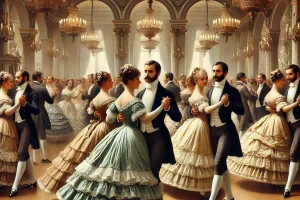
The contradanza was the first European-derived dance form to take root in Cuba and begin transforming under African influence. It is the starting point of the Cuban salon dance lineage that would eventually produce danzón, mambo, and cha-cha-chá.
Lees meer >Danzón was the first national dance of Cuba — the form that unified the island's popular music identity in the late 19th and early 20th century, and the ancestor of mambo, cha-cha-chá, and ultimately timba.
Lees meer >Danzón was the first national dance of Cuba — the form that unified the island's popular music identity in the late 19th and early 20th century, and the ancestor of mambo, cha-cha-chá, and ultimately timba.
Lees meer > Timba is the music this site is dedicated to exploring. It emerged as a distinct genre in the late 1980s and crystallized in the early 1990s — born in a moment of social crisis, built on the full accumulated history of Cuban music, and still evolving today.
Lees meer >The cha-cha-chá was born from a simple observation: dancers were struggling to follow mambo. Its creator gave them a rhythm they could feel in their feet — and the result became one of the most danced music styles in history.
Lees meer > Cuba is the largest island in the Caribbean and the birthplace of some of the world's most influential music and dance traditions. African, Spanish, and French cultural streams collided here over centuries of colonial history, producing an extraordinary creative culture that exported itself across the globe.
Lees meer >The following dances have their origin in Matanzas:
Danzonete is the sung evolution of danzón — the bridge between the purely instrumental danzón of the 19th and early 20th century and the vocal popular music that would follow.
Lees meer >Egungun is the Yoruba masquerade tradition honoring the collective ancestors — the Egun, the dead who remain present and active in the lives of the living. In Cuba, the Egungun tradition survived within the broader world of Santería (Regla de Ocha) and the related Arará and Abakuá communities, though in a form shaped by the specific conditions of the island.
Lees meer >Cuban music is built on percussion. The extraordinary density and variety of Cuban rhythmic culture reflects the meeting of West and Central African drumming traditions with Spanish, Haitian, and creole musical practices over four centuries. The instruments below form the core percussive vocabulary heard across Son, Rumba, Timba, Danzón, and their descendants.
Lees meer >The timpani (kettledrum) played a foundational role in Cuban music history as the original pitched drum of the 19th-century orquesta típica — before being replaced by the lighter timbales.
Lees meer >The timpani (kettledrum) played a foundational role in Cuban music history as the original pitched drum of the 19th-century orquesta típica — before being replaced by the lighter timbales.
Lees meer >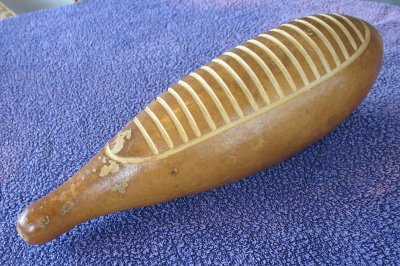
The güiro is a notched gourd scraped with a stick or fork to produce a rasping, rhythmic sound. It is a standard feature of charanga orchestras and is central to danzón, cha-cha-chá, son, and salsa.
Lees meer >The timbales ( pailas criollas) are a pair of shallow, metal-shell drums mounted on a stand, played with wooden sticks. They are the rhythmic engine of charanga orchestras and play a critical role in timba.
Lees meer >The piano is the harmonic and rhythmic heart of Cuban popular music. In timba, it is one of the most demanding and expressive instruments in the ensemble.
Lees meer >The piano is the harmonic and rhythmic heart of Cuban popular music. In timba, it is one of the most demanding and expressive instruments in the ensemble.
Lees meer > Timba, the explosive and rhythmically rich genre of Cuban dance music, transformed how the bass functions in popular music. In Timba, the bass is not just foundational — it’s fiery, funky, and free.
Lees meer >A Cuban popular dance music genre that emerged in the 1980s–90s
- emerged in the 1980s–90s
- influenced by songo, rumba, funk, blues, jazz, pop, rock and Afro-Cuban rhythms.
- Known for complex rhythm shifts, aggressive bass lines, and high energy that push dancers to improvise.
Lees meer >Mambo
In Cuban music, especially in salsa and son,
the "mambo" section typically refers to a brassy, rhythmically intense instrumental break,
often featuring repetitive horn lines, call-and-response patterns, and building energy toward the climax of a song.
The Casa de la Trova in Santiago de Cuba is the spiritual home of Cuban traditional music — Son, Bolero, Changüí, and Trova. Founded in 1968 on Calle Heredia in the heart of Santiago's historic center, it has been the gathering place for the city's musicians for over half a century.
Lees meer >Montuno
🛎️ 1. General Role of the Cowbell
The montuno is the call-and-response section near the end of a salsa or son tune, where everything opens up rhythmically.
- The cowbell pattern becomes steady and driving, often the “salsa bell” pattern:
(Hits on 1, the “&” of 2, 4, and the “&” of 4)
So:
🕐 Cowbell = timekeeper
🎹 Piano = syncopation
🎺 Horns/voices = call & response
- Literally “march down” — this section is calmer, often before the montuno.
- The cowbell is not usually played here.
Instead, you mostly hear congas, bongos, and timbales on softer instruments like the cáscara (timbale shell pattern).
- The rhythm is more subtle, leaving space for vocals or melodic content.
So:
In marcha abajo, the cowbell rests or plays lightly (if at all), and rhythmic emphasis is on cáscara or bongó martillo.
- “March up” — this means the groove intensifies.
- The cowbell comes in strong, providing the main pulse.
- The timbalero usually plays the large cowbell ( campana), while the bongocero might play the smaller bell for contrast.
- This section is about energy and drive — dance climax.
So:
In marcha arriba, the cowbell leads the rhythm section, locking in with the bass and clave to propel the music forward.
🧭 Summary Table
| Section |
Cowbell Player |
Function |
Typical Pattern |
Energy |
| Marcha abajo |
Usually silent or light (cáscara instead) |
Keeps groove subtle |
Cáscara on timbales |
Low–Medium |
| Montuno |
Bongocero (small bell) |
Keeps steady timeline for montuno section |
Salsa bell pattern |
Medium–High |
| Marcha arriba |
Timbalero (big bell) |
Drives rhythm, peak energy |
Salsa bell (louder, heavier) |
High |
Would you like me to add rhythmic notation (in 2–3 and 3–2 clave alignment) for each section’s cowbell pattern? That can make it easier to visualize how it fits with the rest of the rhythm section.
The Casa de la Trova in Santiago de Cuba is the spiritual home of Cuban traditional music — Son, Bolero, Changüí, and Trova. Founded in 1968 on Calle Heredia in the heart of Santiago's historic center, it has been the gathering place for the city's musicians for over half a century.
Lees meer >
The bongo is a pair of small open-bottomed drums played with fingers and palms. It originated in eastern Cuba and became one of the defining percussion voices of son and timba.
Lees meer >
The bongo is a pair of small open-bottomed drums played with fingers and palms. It originated in eastern Cuba and became one of the defining percussion voices of son and timba.
Lees meer >
The bongo is a pair of small open-bottomed drums played with fingers and palms. It originated in eastern Cuba and became one of the defining percussion voices of son and timba.
Lees meer >Cuban Timba & Songo
How to Dance to the Campana (Cowbell)
In Cuban timba and songo, the campana (cowbell) is not just a rhythm — it is a communication system between the band and the dancers.
Lees meer >Cuban Timba & Songo
How to Dance to the Campana (Cowbell)
In Cuban timba and songo, the campana (cowbell) is not just a rhythm — it is a communication system between the band and the dancers.
Lees meer >
The clave is a fundamental rhythmic pattern and organizing principle in Cuban music. It serves as both a musical pattern and a guiding concept, deeply rooted in Afro-Cuban traditions.
Lees meer >The timbales (pailas criollas) are a pair of shallow, metal-shell drums mounted on a stand, played with wooden sticks. They are the rhythmic engine of charanga orchestras and play a critical role in timba.
Lees meer >The piano is the harmonic and rhythmic heart of Cuban popular music. In timba, it is one of the most demanding and expressive instruments in the ensemble.
Lees meer >The piano is the harmonic and rhythmic heart of Cuban popular music. In timba, it is one of the most demanding and expressive instruments in the ensemble.
Lees meer >Timba, the explosive and rhythmically rich genre of Cuban dance music, transformed how the bass functions in popular music. In Timba, the bass is not just foundational — it’s fiery, funky, and free.
Lees meer >The terms "marcha abajo" and "marcha arriba" describe different energy levels or sections within the montuno.
Lees meer >The terms "marcha abajo" and "marcha arriba" describe different energy levels or sections within the montuno.
Lees meer >Montuno
The cowbell
🛎️ 1. General Role of the Cowbell
🎹 2. Montuno Section
The montuno is the call-and-response section near the end of a salsa or son tune, where everything opens up rhythmically.
- The cowbell pattern becomes steady and driving, often the “salsa bell” pattern:
(Hits on 1, the “&” of 2, 4, and the “&” of 4)
- The bongocero switches from hand drums to cowbell at this point.
- The cowbell keeps time over the clave and supports the montuno piano pattern, bass tumbao, and horn riffs.
So:
🕐 Cowbell = timekeeper
🎹 Piano = syncopation
🎺 Horns/voices = call & response
🔻 3. Marcha Abajo (Down Section)
- Literally “march down” — this section is calmer, often before the montuno.
- The cowbell is not usually played here.
Instead, you mostly hear congas, bongos, and timbales on softer instruments like the cáscara (timbale shell pattern).
- The rhythm is more subtle, leaving space for vocals or melodic content.
So:
In marcha abajo, the cowbell rests or plays lightly (if at all), and rhythmic emphasis is on cáscara or bongó martillo.
🔺 4. Marcha Arriba (Up Section)
- “March up” — this means the groove intensifies.
- The cowbell comes in strong, providing the main pulse.
- The timbalero usually plays the large cowbell (campana), while the bongocero might play the smaller bell for contrast.
- This section is about energy and drive — dance climax.
So:
In marcha arriba, the cowbell leads the rhythm section, locking in with the bass and clave to propel the music forward.
🧭 Summary Table
| Section |
Cowbell Player |
Function |
Typical Pattern |
Energy |
| Marcha abajo |
Usually silent or light (cáscara instead) |
Keeps groove subtle |
Cáscara on timbales |
Low–Medium |
| Montuno |
Bongocero (small bell) |
Keeps steady timeline for montuno section |
Salsa bell pattern |
Medium–High |
| Marcha arriba |
Timbalero (big bell) |
Drives rhythm, peak energy |
Salsa bell (louder, heavier) |
High |
Would you like me to add rhythmic notation (in 2–3 and 3–2 clave alignment) for each section’s cowbell pattern? That can make it easier to visualize how it fits with the rest of the rhythm section.
