Son examples - genre
A more developed style (Arsenio Rodríguez in the 1940s), emphasizing call-and-response, montuno sections, and heavier rhythm — this is the direct ancestor of salsa. Instruments:
- Tres (often electric or more percussive style)
- Piano (replacing or joining guitar for harmony and “tumbaos”)
- Double Bass
- Bongó
- Congas (a standard addition now)
- Claves
- Maracas & Güiro
- Multiple Trumpets (or full brass section)
👉 Larger conjuntos (bigger ensembles), strong rhythm section.
Egungun
Egungun is the Yoruba masquerade tradition honoring the collective ancestors — the Egun, the dead who remain present and active in the lives of the living. In Cuba, the Egungun tradition survived within the broader world of Santería (Regla de Ocha) and the related Arará and Abakuá communities, though in a form shaped by the specific conditions of the island.
Lees meer >
Conga

The conga (also called tumbadora) is the primary hand drum of Cuban music and the rhythmic backbone of timba, son, rumba, and salsa.
Lees meer >
Bongo

The bongo is a pair of small open-bottomed drums played with fingers and palms. It originated in eastern Cuba and became one of the defining percussion voices of son and timba.
Lees meer >
Güiro
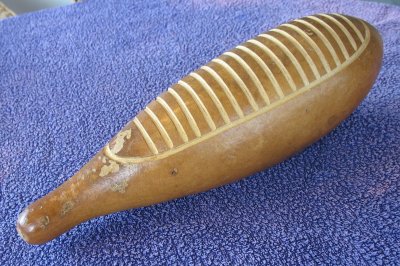
The güiro is a notched gourd scraped with a stick or fork to produce a rasping, rhythmic sound. It is a standard feature of charanga orchestras and is central to danzón, cha-cha-chá, son, and salsa.
Lees meer >
Tres

The tres is a Cuban guitar-like instrument with three pairs (courses) of strings. It is the defining melodic-rhythmic instrument of son cubano and its ancestor genres.
Lees meer >
Guitar
The Spanish guitar arrived in Cuba with the colonizers and became the seed of Cuban music, blending with African rhythms. From inspiring the tres to shaping son, conjuntos, and even modern timba, its influence runs through every note of Cuba’s musical history.
Lees meer >
Piano
The piano is the harmonic and rhythmic heart of Cuban popular music. In timba, it is one of the most demanding and expressive instruments in the ensemble.
Lees meer >
Piano
The piano is the harmonic and rhythmic heart of Cuban popular music. In timba, it is one of the most demanding and expressive instruments in the ensemble.
Lees meer >
The Bass
Timba, the explosive and rhythmically rich genre of Cuban dance music, transformed how the bass functions in popular music. In Timba, the bass is not just foundational — it’s fiery, funky, and free.
Lees meer >
Trombones
The trombone is the defining brass voice of timba. Where earlier Cuban popular music relied primarily on trumpets, timba shifted the brass weight toward trombones — giving the music a deeper, darker, more aggressive horn sound.
Lees meer >
Montuno
The cowbell
🛎️ 1. General Role of the Cowbell
🎹 2. Montuno Section
The montuno is the call-and-response section near the end of a salsa or son tune, where everything opens up rhythmically.
- The cowbell pattern becomes steady and driving, often the “salsa bell” pattern:
(Hits on 1, the “&” of 2, 4, and the “&” of 4)
- The bongocero switches from hand drums to cowbell at this point.
- The cowbell keeps time over the clave and supports the montuno piano pattern, bass tumbao, and horn riffs.
So:
🕐 Cowbell = timekeeper
🎹 Piano = syncopation
🎺 Horns/voices = call & response
🔻 3. Marcha Abajo (Down Section)
- Literally “march down” — this section is calmer, often before the montuno.
- The cowbell is not usually played here.
Instead, you mostly hear congas, bongos, and timbales on softer instruments like the cáscara (timbale shell pattern). - The rhythm is more subtle, leaving space for vocals or melodic content.
So:
In marcha abajo, the cowbell rests or plays lightly (if at all), and rhythmic emphasis is on cáscara or bongó martillo.
🔺 4. Marcha Arriba (Up Section)
- “March up” — this means the groove intensifies.
- The cowbell comes in strong, providing the main pulse.
- The timbalero usually plays the large cowbell ( campana), while the bongocero might play the smaller bell for contrast.
- This section is about energy and drive — dance climax.
So:
In marcha arriba, the cowbell leads the rhythm section, locking in with the bass and clave to propel the music forward.
🧭 Summary Table
| Section | Cowbell Player | Function | Typical Pattern | Energy |
|---|---|---|---|---|
| Marcha abajo | Usually silent or light (cáscara instead) | Keeps groove subtle | Cáscara on timbales | Low–Medium |
| Montuno | Bongocero (small bell) | Keeps steady timeline for montuno section | Salsa bell pattern | Medium–High |
| Marcha arriba | Timbalero (big bell) | Drives rhythm, peak energy | Salsa bell (louder, heavier) | High |
Would you like me to add rhythmic notation (in 2–3 and 3–2 clave alignment) for each section’s cowbell pattern? That can make it easier to visualize how it fits with the rest of the rhythm section.
Casa de la Trova
The Casa de la Trova in Santiago de Cuba is the spiritual home of Cuban traditional music — Son, Bolero, Changüí, and Trova. Founded in 1968 on Calle Heredia in the heart of Santiago's historic center, it has been the gathering place for the city's musicians for over half a century.
Lees meer >
Conga
The conga (also called tumbadora) is the primary hand drum of Cuban music and the rhythmic backbone of timba, son, rumba, and salsa.
Lees meer >
Bongo
The bongo is a pair of small open-bottomed drums played with fingers and palms. It originated in eastern Cuba and became one of the defining percussion voices of son and timba.
Lees meer >
Bongo
The bongo is a pair of small open-bottomed drums played with fingers and palms. It originated in eastern Cuba and became one of the defining percussion voices of son and timba.
Lees meer >
Bongo
The bongo is a pair of small open-bottomed drums played with fingers and palms. It originated in eastern Cuba and became one of the defining percussion voices of son and timba.
Lees meer >
Cowbell
Cuban Timba & Songo
How to Dance to the Campana (Cowbell)
In Cuban timba and songo, the campana (cowbell) is not just a rhythm — it is a communication system between the band and the dancers.
Lees meer >
Cowbell
Cuban Timba & Songo
How to Dance to the Campana (Cowbell)
In Cuban timba and songo, the campana (cowbell) is not just a rhythm — it is a communication system between the band and the dancers.
Lees meer >
Clave

The clave is a fundamental rhythmic pattern and organizing principle in Cuban music. It serves as both a musical pattern and a guiding concept, deeply rooted in Afro-Cuban traditions.
Lees meer >
Timbales
The timbales (pailas criollas) are a pair of shallow, metal-shell drums mounted on a stand, played with wooden sticks. They are the rhythmic engine of charanga orchestras and play a critical role in timba.
Lees meer >
Piano
The piano is the harmonic and rhythmic heart of Cuban popular music. In timba, it is one of the most demanding and expressive instruments in the ensemble.
Lees meer >
Piano
The piano is the harmonic and rhythmic heart of Cuban popular music. In timba, it is one of the most demanding and expressive instruments in the ensemble.
Lees meer >
The Bass
Timba, the explosive and rhythmically rich genre of Cuban dance music, transformed how the bass functions in popular music. In Timba, the bass is not just foundational — it’s fiery, funky, and free.
Lees meer >
Marcha arriba
The terms "marcha abajo" and "marcha arriba" describe different energy levels or sections within the montuno.
Lees meer >
Marcha abajo
The terms "marcha abajo" and "marcha arriba" describe different energy levels or sections within the montuno.
Lees meer >
Montuno
The cowbell
🛎️ 1. General Role of the Cowbell
🎹 2. Montuno Section
The montuno is the call-and-response section near the end of a salsa or son tune, where everything opens up rhythmically.
- The cowbell pattern becomes steady and driving, often the “salsa bell” pattern:
(Hits on 1, the “&” of 2, 4, and the “&” of 4)
- The bongocero switches from hand drums to cowbell at this point.
- The cowbell keeps time over the clave and supports the montuno piano pattern, bass tumbao, and horn riffs.
So:
🕐 Cowbell = timekeeper
🎹 Piano = syncopation
🎺 Horns/voices = call & response
🔻 3. Marcha Abajo (Down Section)
- Literally “march down” — this section is calmer, often before the montuno.
- The cowbell is not usually played here.
Instead, you mostly hear congas, bongos, and timbales on softer instruments like the cáscara (timbale shell pattern). - The rhythm is more subtle, leaving space for vocals or melodic content.
So:
In marcha abajo, the cowbell rests or plays lightly (if at all), and rhythmic emphasis is on cáscara or bongó martillo.
🔺 4. Marcha Arriba (Up Section)
- “March up” — this means the groove intensifies.
- The cowbell comes in strong, providing the main pulse.
- The timbalero usually plays the large cowbell (campana), while the bongocero might play the smaller bell for contrast.
- This section is about energy and drive — dance climax.
So:
In marcha arriba, the cowbell leads the rhythm section, locking in with the bass and clave to propel the music forward.
🧭 Summary Table
| Section | Cowbell Player | Function | Typical Pattern | Energy |
|---|---|---|---|---|
| Marcha abajo | Usually silent or light (cáscara instead) | Keeps groove subtle | Cáscara on timbales | Low–Medium |
| Montuno | Bongocero (small bell) | Keeps steady timeline for montuno section | Salsa bell pattern | Medium–High |
| Marcha arriba | Timbalero (big bell) | Drives rhythm, peak energy | Salsa bell (louder, heavier) | High |
Would you like me to add rhythmic notation (in 2–3 and 3–2 clave alignment) for each section’s cowbell pattern? That can make it easier to visualize how it fits with the rest of the rhythm section.