Beyond Salsa for Beginners - book
Beyond Salsa for Beginners:
The Cuban Timba Revolution: An Introduction to Latin Music for Dancers and Listeners
🎶 Beyond Salsa: A Listener’s Guide to Cuban and Latin Music
📘 Overview
After writing over 20 instructional books on Cuban piano, congas, drums, timbales, clave, and bass, Kevin Moore has created his first book for non-musicians — listeners, dancers, and fans of Latin music.
Beyond Salsa bridges the gap between performers and enthusiasts, offering both a historical perspective and hands-on rhythm training.
🎧 Structure of the Book
1. Listening Tours
These sections guide readers through the evolution of Cuban and Latin popular music — complete with song analysis, music history, and record-collecting advice.
The Four Listening Tours:
- Pre-Revolution Cuban Popular Music (1900–1959)
- Salsa and Post-Revolution Cuban Popular Music (1959–1989)
- Timba (1989–2012)
- Afro-Cuban Folkloric Music, Comparsa, Changüí, and Rumba
2. Rhythm Exercises
Practical chapters with singing, clapping, and dancing exercises designed to develop a deep internal sense of rhythm.
Includes:
- The basic rhythms of each instrument
- Clave fundamentals
- Essential dance steps
- Guidance on how to feel the Latin groove naturally
- A special chapter addressing common challenges new listeners face when hearing Afro-Cuban folkloric rhythms
🔊 Audio Resources
- 🎵 Free audio download with 107 tracks corresponding to the rhythm exercises
- 💿 Optional paid download with additional examples and practice material
📚 Extras
- Extensive glossary of musical and cultural terms
- Beginner’s guide to Spanish and Cuban slang in music, written for English speakers
🕺 Who It’s For
“Beyond Salsa” is the perfect companion for anyone who loves Latin music — dancers, DJs, listeners, or musicians who want to understand the groove from the inside out.
- No clave
- Feet not lifted of the ground
The dance features a shuffling footwork style—dancers glide their feet rather than lifting them.
- Originated in Guantánamo
Lees meer >Cuban rumba is an Afro-Cuban music and dance genre characterized by complex rhythms, call-and-response vocals, and expressive, often flirtatious movements, rooted in African and Spanish traditions.
Lees meer >
The clave is a fundamental rhythmic pattern and organizing principle in Cuban music. It serves as both a musical pattern and a guiding concept, deeply rooted in Afro-Cuban traditions.
Lees meer >Timbales
History
Timbales were introduced in Cuban danzón during the late 19th century.
Here’s how it happened:
- The earliest danzón was played by orquestas típicas, which used heavier European-style timpani and military-style percussion.
- Around the 1870s–1880s, these large drums were replaced by the pailas criollas (what we now call timbales). They were lighter, more agile metal drums better suited for Cuban dance rhythms.
- This innovation helped shape the charanga francesa ensemble (flute, violins, piano, bass, güiro, timbales), which became the standard for danzón, danzonete, and later chachachá.
👉 So, the timbales first entered Cuban music through danzón and then became central to many genres afterwards ( mambo, salsa, songo, timba).
National dance of Cuba, evolved from danza.
Lees meer >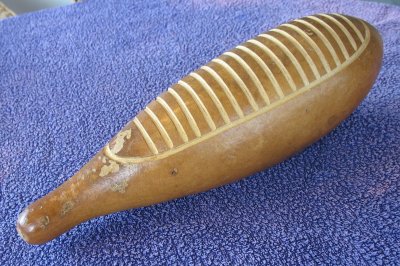
The güiro is central to danzón, cha-cha-chá, son, and salsa, and is a standard feature of charanga orchestras that popularized Cuban dance music in the 20th century.
Lees meer >Origins
Inventor: Bartolomeo Cristofori (1655–1731), an Italian instrument maker in Florence.
Date: Around 1700, Cristofori built the first instrument he called a “gravicembalo col piano e forte” — meaning harpsichord with soft and loud.
Lees meer >Timba, the explosive and rhythmically rich genre of Cuban dance music, transformed how the bass functions in popular music. In Timba, the bass is not just foundational — it’s fiery, funky, and free.
Lees meer >Dances
- Danzón – The quintessential Cuban ballroom dance, elegant and formal, often seen as the "national dance of Cuba."
- Danzonete – A sung variant of danzón that became popular in the 1920s–30s.
- Cha-cha-chá – Created in the 1950s by Enrique Jorrín while playing with a charanga; specifically designed for charanga orchestras.
- Pachanga – A playful dance and rhythm from the late 1950s/early 1960s, closely linked to charanga bands.
- Mambo (in its earlier Cuban form) – Before the big-band New York mambo, charangas also played early mambo-style danzones.
- Charanga is a Cuban ensemble style and musical tradition that dates back to the early 20th century. It became especially popular in the 1940s–50s and played a crucial role in the evolution of salsa, timba, and Latin jazz.
Lees meer >A Cuban popular dance music genre that emerged in the 1980s–90s
- emerged in the 1980s–90s
- influenced by songo, rumba, funk, blues, jazz, pop, rock and Afro-Cuban rhythms.
- Known for complex rhythm shifts, aggressive bass lines, and high energy that push dancers to improvise.
Lees meer >Mambo
In Cuban music, especially in salsa and son,
the " mambo" section typically refers to a brassy, rhythmically intense instrumental break,
often featuring repetitive horn lines, call-and-response patterns, and building energy toward the climax of a song.
- Son traditional
- Son urbano
- Son montuno
- Son moderno.
Lees meer >Mambo
In Cuban music, especially in salsa and son,
the "mambo" section typically refers to a brassy, rhythmically intense instrumental break,
often featuring repetitive horn lines, call-and-response patterns, and building energy toward the climax of a song.
Origins
Inventor: Bartolomeo Cristofori (1655–1731), an Italian instrument maker in Florence.
Date: Around 1700, Cristofori built the first instrument he called a “gravicembalo col piano e forte” — meaning harpsichord with soft and loud.
Lees meer >Timba, the explosive and rhythmically rich genre of Cuban dance music, transformed how the bass functions in popular music. In Timba, the bass is not just foundational — it’s fiery, funky, and free.
Lees meer >A Cuban popular dance music genre that emerged in the 1980s–90s
- emerged in the 1980s–90s
- influenced by songo, rumba, funk, blues, jazz, pop, rock and Afro-Cuban rhythms.
- Known for complex rhythm shifts, aggressive bass lines, and high energy that push dancers to improvise.
Lees meer >