Miguel Faílde
Creator of the danzón — Miguel Faílde composed Las Alturas de Simpson in 1879, the piece recognized as the first danzón, establishing Cuba's national dance form for the next half century.
Background
Faílde was born on October 18, 1852, in Matanzas, the port city on Cuba's northern coast that served as one of the most important centers of Afro-Cuban cultural life in the 19th century. Matanzas was a hub of sugar production, a city with a large enslaved and free Black population, and the birthplace of several of Cuba's most significant Afro-Cuban musical and religious traditions — including Rumba and the Lucumí ( Yoruba) ceremonial music that would become Santería.
He trained as a musician in Matanzas and led his own orquesta típica — the large dance band format of the era, featuring brass, violins, piano, and percussion. These orchestras played at the dance salons, social clubs, and public events that were central to colonial Cuban society.
"Las Alturas de Simpson" and the Birth of Danzón
On January 1, 1879, Faílde premiered "Las Alturas de Simpson" at the Club Liceo in Matanzas. The composition was named after a neighborhood in Matanzas, and its premiere is considered the birth of the danzón as a formal genre.
The danzón evolved from the contradanza (Cuban contradance), itself a Cuban adaptation of the French contredanse, transformed by Afro-Cuban rhythmic sensibilities over the 18th and early 19th centuries. Faílde's key innovation was structural: a new final section — later called the nuevo ritmo or estribillo (refrain) — in which the ensemble played an improvisatory, rhythmically active passage with a distinctly Afro-Cuban character, breaking from the more formal, European character of the earlier contradanza.
The structure Faílde established became the template for all subsequent danzón:
- Paseo (introduction) — full ensemble, repeated
- Clarinet section — melodic theme
- Violin section — melodic theme
- Nuevo ritmo section — the climactic, rhythmically active final section
Why It Was Revolutionary
The danzón's significance in 1879 was not merely musical — it was social. Cuban society of the late 19th century was racially stratified and politically volatile: the Ten Years' War (1868–1878) had just ended, slavery would not be fully abolished until 1886, and Cuban identity was being actively contested. The danzón embodied a Cuban (rather than purely Spanish or French-colonial) musical identity, blending European formal structures with Afro-Cuban rhythmic life.
The dance that accompanied it — partners in close embrace, moving in small, contained steps with subtle hip movement — was considered scandalous by conservative elements and defended fiercely by Cubans who saw it as an expression of national character.
Legacy
Faílde's invention set the trajectory for Cuban popular dance music for the next century. The danzón itself evolved continuously:
- The danzonete (1929, Aniceto Díaz) added vocals
- The danzón-mambo (late 1930s–40s, Orestes López and Arcaño y sus Maravillas) electrified the final section with syncopated jazz influences
- The mambo (Pérez Prado) and the cha-cha-chá (Enrique Jorrín) both grew from the danzón's final section
Miguel Faílde died in Matanzas on April 26, 1921, having lived to see the music he created become the national dance of the country he loved. He is honored in Matanzas with a monument, and "Las Alturas de Simpson" remains the foundational text of Cuban dance music.
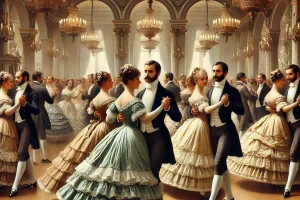
The contradanza was the first European-derived dance form to take root in Cuba and begin transforming under African influence. It is the starting point of the Cuban salon dance lineage that would eventually produce danzón, mambo, and cha-cha-chá.
Lees meer >
The contradanza was the first European-derived dance form to take root in Cuba and begin transforming under African influence. It is the starting point of the Cuban salon dance lineage that would eventually produce danzón, mambo, and cha-cha-chá.
Lees meer >Rumba is the most African-rooted of all Cuban music and dance forms — born in the streets, courtyards, and docks of Havana and Matanzas in the late 19th century, with no European instruments, no salon setting, and no pretense of European propriety.
Lees meer >The cha-cha-chá was born from a simple observation: dancers were struggling to follow mambo. Its creator gave them a rhythm they could feel in their feet — and the result became one of the most danced music styles in history.
Lees meer > Cuba is the largest island in the Caribbean and the birthplace of some of the world's most influential music and dance traditions. African, Spanish, and French cultural streams collided here over centuries of colonial history, producing an extraordinary creative culture that exported itself across the globe.
Lees meer >The following dances have their origin in Matanzas:
Nigeria — home to the Yoruba, Igbo, and Efik peoples — is the single most influential African source for Afro-Cuban religion and dance. Enslaved Yoruba brought to Cuba preserved their cosmology through Santería, and their descendants' dances remain at the core of Cuban folkloric and popular movement vocabulary today.
Lees meer >Danzonete is the sung evolution of danzón — the bridge between the purely instrumental danzón of the 19th and early 20th century and the vocal popular music that would follow.
Lees meer >Egungun is the Yoruba masquerade tradition honoring the collective ancestors — the Egun, the dead who remain present and active in the lives of the living. In Cuba, the Egungun tradition survived within the broader world of Santería (Regla de Ocha) and the related Arará and Abakuá communities, though in a form shaped by the specific conditions of the island.
Lees meer >Cuban music is built on percussion. The extraordinary density and variety of Cuban rhythmic culture reflects the meeting of West and Central African drumming traditions with Spanish, Haitian, and creole musical practices over four centuries. The instruments below form the core percussive vocabulary heard across Son, Rumba, Timba, Danzón, and their descendants.
Lees meer >The piano is the harmonic and rhythmic heart of Cuban popular music. In timba, it is one of the most demanding and expressive instruments in the ensemble.
Lees meer >In timba (the Cuban genre that evolved from son and salsa in the late 1980s and 1990s), the violin is not a core instrument, but it does appear in interesting ways:
Lees meer >The trombone is the defining brass voice of timba. Where earlier Cuban popular music relied primarily on trumpets, timba shifted the brass weight toward trombones — giving the music a deeper, darker, more aggressive horn sound.
Lees meer >Mambo
In Cuban music, especially in salsa and son,
the "mambo" section typically refers to a brassy, rhythmically intense instrumental break,
often featuring repetitive horn lines, call-and-response patterns, and building energy toward the climax of a song.
The Casa de la Trova in Santiago de Cuba is the spiritual home of Cuban traditional music — Son, Bolero, Changüí, and Trova. Founded in 1968 on Calle Heredia in the heart of Santiago's historic center, it has been the gathering place for the city's musicians for over half a century.
Lees meer >