Charangas & Orquestas
The salon orchestras of Cuban dance music — flute, violins, piano, bass, timbales, and güiro — the format that produced Danzón, Mambo, and Cha-cha-chá.
The charanga (or charanga francesa) was the dominant Cuban dance orchestra format from the late 19th century through the 1950s. Its distinctive instrumentation — French flute leading over strings rather than brass — gave Cuban ballroom music its elegant, melodic character. From this format came the Danzón, the Mambo, and the Cha-cha-chá.
The cha-cha-chá was born from a simple observation: dancers were struggling to follow mambo. Its creator gave them a rhythm they could feel in their feet — and the result became one of the most danced music styles in history.
Lees meer >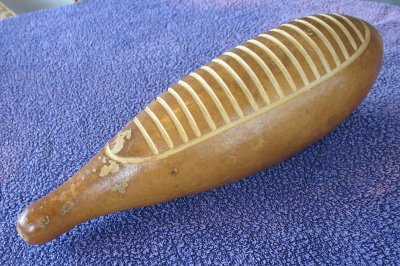
The güiro is a notched gourd scraped with a stick or fork to produce a rasping, rhythmic sound. It is a standard feature of charanga orchestras and is central to danzón, cha-cha-chá, son, and salsa.
Lees meer >The timbales ( pailas criollas) are a pair of shallow, metal-shell drums mounted on a stand, played with wooden sticks. They are the rhythmic engine of charanga orchestras and play a critical role in timba.
Lees meer >The piano is the harmonic and rhythmic heart of Cuban popular music. In timba, it is one of the most demanding and expressive instruments in the ensemble.
Lees meer > Timba, the explosive and rhythmically rich genre of Cuban dance music, transformed how the bass functions in popular music. In Timba, the bass is not just foundational — it’s fiery, funky, and free.
Lees meer >The trombone is the defining brass voice of timba. Where earlier Cuban popular music relied primarily on trumpets, timba shifted the brass weight toward trombones — giving the music a deeper, darker, more aggressive horn sound.
Lees meer >Mambo
In Cuban music, especially in salsa and son,
the "mambo" section typically refers to a brassy, rhythmically intense instrumental break,
often featuring repetitive horn lines, call-and-response patterns, and building energy toward the climax of a song.
The Casa de la Trova in Santiago de Cuba is the spiritual home of Cuban traditional music — Son, Bolero, Changüí, and Trova. Founded in 1968 on Calle Heredia in the heart of Santiago's historic center, it has been the gathering place for the city's musicians for over half a century.
Lees meer >